
150+ Web 2.0 Submission Sites List for 2026: High DA Dofollow Platforms
Web 2.0 submission sites allow search marketers to build user-controlled subdomains on established root domains to publish contextual content and pass topical authority. Utilize our verified directory of high DA dofollow Web 2.0 platforms below to diversify backlink profiles.
Web 2.0 properties represent user-generated web publishing platforms where individuals establish personal blogs, digital hubs, and multimedia repositories on trusted domain architectures.
Search engine algorithms recognize authority domains like WordPress, Blogger, and Medium as trustworthy root entities with massive historical link equity and search crawling frequency.
Creating branded Web 2.0 properties allows SEO practitioners to build high-relevance contextual backlinks within editorial articles that support primary money site rankings.

The Web 2.0 submission hierarchy illustrates how high-authority subdomains channel topical link equity toward target landing pages. Structuring multi-tiered Web 2.0 networks protects root domains while insulating primary assets from algorithmic turbulence.
Top 25 High DA Dofollow Web 2.0 Blogging Sites in 2026
The highest-performing Web 2.0 platforms combine high Domain Authority scores, stable subdomains, indexation velocity, and customizable HTML publishing controls. Review the verified ranking matrix below to select optimal web properties for your content syndication campaigns.
| Web 2.0 Platform | Root URL | Domain Authority | Link Attribute | Index Speed |
|---|---|---|---|---|
| WordPress.com | wordpress.com | DA 94 | Dofollow | Under 24 Hours |
| Blogger | blogspot.com | DA 99 | Dofollow | Under 12 Hours |
| Medium | medium.com | DA 95 | Nofollow | Under 6 Hours |
| Wix | wixsite.com | DA 93 | Dofollow | 1 to 3 Days |
| Weebly | weebly.com | DA 92 | Dofollow | 1 to 2 Days |
| Tumblr | tumblr.com | DA 99 | Dofollow | Under 24 Hours |
| Substack | substack.com | DA 91 | Dofollow | Under 12 Hours |
| Ghost | ghost.io | DA 88 | Dofollow | 1 to 2 Days |
| LiveJournal | livejournal.com | DA 91 | Nofollow | 2 to 4 Days |
| Jimdo | jimdosite.com | DA 87 | Dofollow | 2 to 3 Days |
| HubPages | hubpages.com | DA 89 | Nofollow | Under 24 Hours |
| Strikingly | mystrikingly.com | DA 86 | Dofollow | 2 to 4 Days |
| Yola | yolasite.com | DA 85 | Dofollow | 3 to 5 Days |
| Site123 | site123.me | DA 84 | Dofollow | 2 to 4 Days |
| Webnode | webnode.page | DA 86 | Dofollow | 2 to 3 Days |
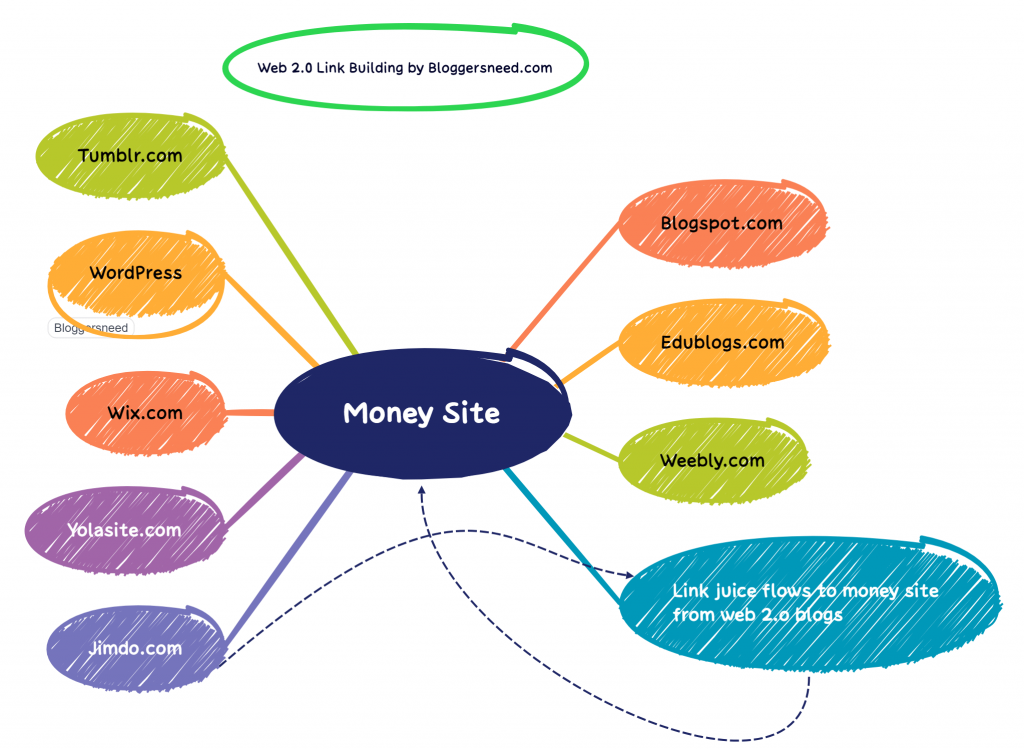
This strategic mind map illustrates tiered link building architectures separating satellite properties from primary landing pages. Channelling secondary link equity through intermediate Web 2.0 hubs amplifies crawl authority without risking algorithmic over-optimization.
Document and Content Sharing Web 2.0 Submission Platforms
Document sharing and presentation platforms provide high-trust backlink opportunities by embedding outbound URLs within PDF guides and slide presentations. These established platforms rank strongly in Google for long-tail informational search queries.
| Platform Name | Supported Formats | Domain Authority | Link Classification |
|---|---|---|---|
| SlideShare | PDF, PPT, Keynote | DA 95 | Nofollow (High Referral) |
| Issuu | PDF Magazines & Ebooks | DA 94 | Dofollow In Profile |
| Scribd | Documents, Research Papers | DA 93 | Nofollow |
| Wattpad | Stories, Longform Articles | DA 91 | Dofollow Profile |
Step-by-Step Tiered Link Building Strategy with Web 2.0 Sites
Executing a sustainable Web 2.0 link building campaign requires treating satellite properties as genuine independent niche blogs. Follow the four operational execution phases below to build resilient multi-tiered backlink authority.
Phase 1: Brand Profile Setup and Persona Creation
Create unique author personas across each Web 2.0 site with custom profile avatars, realistic bios, and authentic contact pages. Neglecting fundamental profile components signals automated spam creation to web security filters.
Use distinct email addresses and varied registration usernames to prevent linking footprint correlations across multiple properties.
Phase 2: Publishing Foundational Seed Content
Publish two to three comprehensive seed articles on each property before inserting any outbound backlinks to your target money website. Establishing initial topical relevance without commercial links signals authentic editorial intent to search spiders.
Incorporate royalty-free images, relevant YouTube embeds, and authoritative non-competing external citations to build contextual legitimacy.
Phase 3: Contextual Link Insertion with Natural Anchor Text
Embed target URLs within high-quality contextual sentences using diverse anchor text categories including branded phrases and naked URLs. Over-optimizing exact-match commercial anchor texts can trigger search engine algorithmic review.
Search marketers can monitor anchor text dispersion using verified backlink analyzer tools to ensure natural ratio distributions.
Phase 4: Powering Tier-1 Web 2.0s with Automated Tier-2 Links
Directing secondary automated backlinks toward your Tier-1 Web 2.0 subdomains accelerates page authority without exposing your primary website. This tiered buffer structure safely passes link equity through established root authority domains.
Professional SEOs build tier-2 link volume using dedicated backlink SEO software platforms like RankerX and Money Robot.
To speed up crawl discovery, submit newly created Web 2.0 URLs to verified website indexing services to ensure search engines record the backlinks.
Top 15 Microblogging and Community Discussion Web 2.0 Sites
Microblogging and social curation platforms provide high-authority referral backlinks and brand profile citations across trusted global user communities. Publishing curated summaries and discussion threads drives targeted visitor traffic while reinforcing root domain trust.
| Community Platform | Root URL | Domain Authority | Link Classification |
|---|---|---|---|
| reddit.com | DA 98 | Nofollow (High Viral Reach) | |
| Quora | quora.com | DA 93 | Nofollow Contextual |
| LinkedIn Articles | linkedin.com/pulse | DA 99 | Nofollow Authority |
| pinterest.com | DA 94 | Dofollow Direct Pins | |
| Scoop.it | scoop.it | DA 87 | Dofollow Curations |
| Diigo | diigo.com | DA 88 | Dofollow Bookmarks |
Tiered Link Architecture: Tier 1 vs Tier 2 vs Tier 3 Buffer Modeling
Tiered link building organizes backlink acquisition into structured layers to pass search authority safely without exposing your money website to penalties. The architectural model insulates primary business assets from automated link volume.
Tier 1: High-Relevance Handcrafted Web 2.0 Blogs
Tier-1 Web 2.0 properties link directly to your target landing pages using descriptive branded and partial-match anchor text phrases. These properties require handwritten longform articles, custom media graphics, and natural outgoing authority citations.
Maintaining high editorial standards on Tier 1 ensures that Google algorithms view the referring subdomains as trustworthy niche publications.
Tier 2: Supporting Automation Buffers and Secondary Blogs
Tier-2 links point exclusively toward your Tier-1 Web 2.0 articles to increase their Page Authority and indexing stability. Marketers build hundreds of contextual links across secondary Web 2.0s, wikis, and high-trust social bookmarks.
Because Tier 2 links never touch your primary domain, search engines never attribute secondary link velocity directly to your commercial website.
Tier 3: Mass Volume Indexation and Profile Reinforcements
Tier-3 links consist of high-volume social signals, forum bookmarks, and profile links designed to power Tier-2 properties. This broad foundation ensures search engine spiders crawl the entire multi-tiered linking network continuously.
How to Index Web 2.0 Backlinks Fast in Google
Indexing Web 2.0 backlinks rapidly requires combining social sharing signals, RSS feed syndication, and dedicated search engine index submission tools. Without search engine indexation, published links cannot transfer PageRank authority or influence search rankings.
RSS Feed Generation and Directory Submission
Extracting the RSS feed URL from your Web 2.0 blog allows you to submit updates to international RSS feed aggregators. Search spiders monitor major RSS directories continuously to discover newly published blog entries.
Social Amplification and Social Bookmarking
Sharing your newly created Web 2.0 URLs across Twitter, Pinterest, and Reddit generates immediate social referral clicks and crawl activity. Search engine bots trace shared social links quickly to inspect destination web documents.
Best Practices to Avoid Web 2.0 Account Deletion and Penalties
Web 2.0 platform administrators utilize automated moderation bots to detect and terminate low-effort promotional link spam subdomains. Adhering to strict content standards preserves your published links permanently.
First, never copy identical article text across multiple Web 2.0 accounts. Duplicate spun content triggers automated moderation bans within days of publication.
Second, ensure each article exceeds eight hundred words with structured headings and informative media elements to satisfy minimum content quality filters.
Third, interlink related Web 2.0 properties naturally within topical categories rather than creating closed link wheel footprints that search engines identify easily.
Frequently Asked Questions About Web 2.0 Submission Sites
Review practical answers to common questions regarding Web 2.0 link building tactics, indexing timelines, and algorithmic safety.
Do Web 2.0 backlinks still work in SEO?
Yes, Web 2.0 backlinks remain effective when published on active, high-quality subdomains containing informative unique content. They provide valuable link diversity and contextual relevance, especially when used within tiered link building structures.
How long does it take for Web 2.0 links to get indexed by Google?
Web 2.0 articles published on high-authority platforms like Medium or Blogger typically index within twenty-four to forty-eight hours. Smaller platforms may take two to four weeks unless supported by tier-2 links or indexing services.
What is the difference between dofollow and nofollow Web 2.0 sites?
Dofollow Web 2.0 sites pass search engine PageRank equity directly to your target URL, whereas nofollow sites pass referral traffic and link diversity. A healthy link profile maintains a natural blend of both dofollow and nofollow referring domains.
How many Web 2.0 links should I build per month?
Building five to ten high-quality Tier-1 Web 2.0 properties monthly ensures steady, natural link acquisition velocity for growing sites. Consistent incremental link acquisition mimics authentic organic brand popularity far better than sudden unnatural volume spikes.
Should I point Web 2.0 links directly to my money site?
Yes, high-quality handwritten Web 2.0 properties with substantial content can safely link directly to your money site as Tier-1 assets. However, automated mass-generated Web 2.0 sites should only be deployed as Tier-2 or Tier-3 supporting buffers.

I’m Abdullah Prem, a passionate blogger with over 10 years of experience. I created BloggersNeed to produce high-quality, easy-to-understand articles, guides, and tutorials that help people start their blogging journey. Specializing in WordPress, Hosting, Themes, and online money-making strategies, I’ve been featured on leading tech platforms such as Tech.co, Cloudways, Business2Community, Leadpages, GoodFirms, and ShareThis. BloggersNeed.com
Comments are closed.