
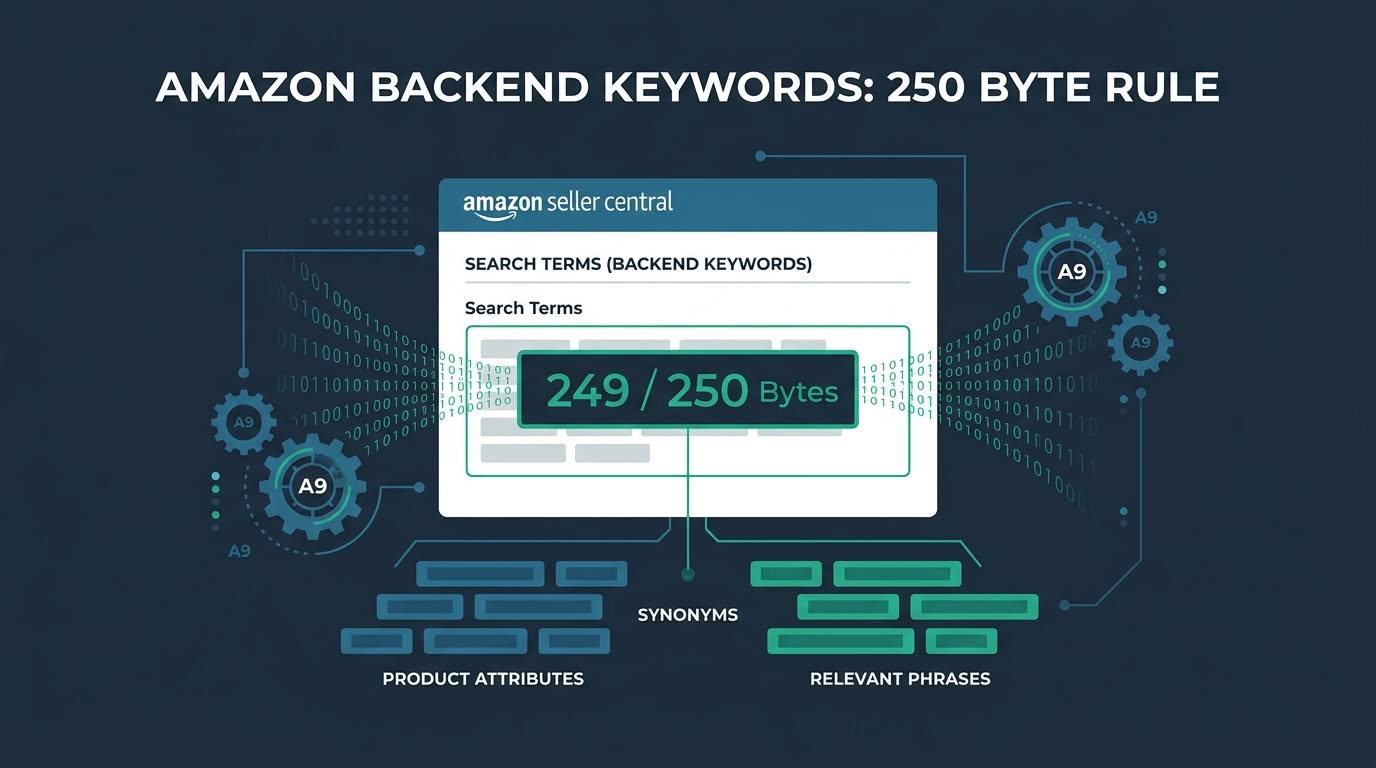
⚡ The Golden Rules of Amazon Backend Keywords in 2026
- Strict 249-Byte Ceiling: Keep your Search Terms field strictly under 250 bytes (meaning 249 bytes or fewer). If your input reaches 250 bytes, Amazon completely ignores the entire field!
- Bytes vs. Characters: Standard alphanumeric letters (A–Z, 0–9) equal 1 byte, but special characters (ä, é, ©) consume 2 to 4 bytes.
- Zero Repetition & No Commas: Separate words with single spaces only. Do not repeat words already in your title or bullets, do not include punctuation, and never add competitor brand names.
Optimizing your Amazon backend keywords is one of the most powerful organic ranking levers available to Amazon FBA sellers and brand owners. Hidden inside the catalog editing interface of Amazon Seller Central, the “Search Terms” field allows sellers to index their products for high-intent search phrases, misspellings, colloquial slang, and foreign language translations without cluttering public customer-facing listing copy.
However, the backend search field is governed by a strict algorithmic enforcement mechanism: the 250-byte rule. Misunderstanding how Amazon measures bytes versus characters can lead to listing suppression, causing your product to miss thousands of potential sales.
Table of Contents
What Are Amazon Backend Keywords (Search Terms)?
Amazon backend keywords – officially designated as Search Terms inside Seller Central – are invisible metadata tags associated with your ASIN. When Amazon’s A10 search engine scans a product listing to decide whether it qualifies to appear for a customer query, it evaluates both frontend text (Title, Bullets, Product Description) and backend text (Search Terms, Intended Use, Target Audience).
Harvesting high-relevance search terms before assembling backend strings requires dedicated keyword suites. Consult our evaluation in the BloggersNeed Amazon keyword search volume software guide to discover high-intent shopper phrases across your category.
The primary advantage of backend keywords is that they allow you to target valuable customer search queries that would look unnatural or unprofessional in your public sales copy. For instance, common spelling mistakes (e.g., garlic pres, minser), alternate dialect expressions (e.g., aubergine vs. eggplant), and Spanish translation phrases can be indexed in the backend without confusing English shoppers.
To extract competitor backend keywords and unearth hidden indexing gaps, explore our detailed review of the BloggersNeed reverse ASIN lookup tools benchmark.
The 250-Byte Rule Explained: Bytes vs. Characters
The most frequent mistake sellers make is confusing character count with byte size. Amazon’s official documentation explicitly specifies that the Search Terms field limit is less than 250 bytes (i.e., maximum 249 bytes).
In computer architecture, data storage is measured in bytes using UTF-8 encoding:
- 1 Byte Characters: Basic English letters (a–z, A–Z), standard numbers (0–9), and spaces each consume exactly 1 byte.
- 2 Byte Characters: Accented letters used in European languages (such as ä, é, ö, ü, ñ) consume 2 bytes each.
- 3 Byte Characters: Symbols and complex scripts (such as Japanese Kanji, Chinese characters, and currency symbols like €) consume 3 bytes each.
- 4 Byte Characters: Emojis and rare historical scripts consume 4 bytes each.
If you write a backend string containing 245 English characters and accidentally paste a single German umlaut (e.g., “für”) or an emoji, your total byte size may reach 251 bytes, even though your character count looks well under 250.
What Happens If You Exceed 249 Bytes? (The Silent De-indexing Penalty)
Amazon enforces byte limits through an unforgiving binary rule. If your Search Terms string reaches 250 bytes or greater, Amazon’s algorithm does not simply truncate the excess words – it silently rejects the entire Search Terms field.
When this silent de-indexing penalty occurs, Seller Central will not display an error message or alert you. The form saves successfully, but in the backend search index, none of your backend keywords are indexed. Your product immediately loses organic eligibility for every phrase housed in that box.
Because of this silent failure risk, professional sellers always target 245 to 248 bytes, leaving a safety buffer to ensure complete algorithmic indexation.
What to Include in Your Backend Search Terms
Because you only have 249 bytes of space, every single byte must be utilized with strategic discipline. Focus exclusively on these high-value keyword types:
- High-Frequency Synonyms: Alternative terms customers use for your item that did not fit naturally into your title or bullets (e.g., if your title says cutting board, place chopping block, butcher block, carving board in the backend).
- Common Spelling Mistakes: Frequently misspelled terms that buyers regularly type into search (e.g., straightner, dumbells, protein shacker).
- Spanish Language Translations: In the US marketplace, millions of shoppers search exclusively in Spanish. Adding high-traffic Spanish translations (e.g., prensa de ajo for garlic press) unlocks massive low-competition search volume.
- Hyper-Specific Long-Tail Modifiers: Niche customer descriptors such as travel size, camping gadget, ergonomic grip, heavy duty.
What NEVER to Include in Your Backend Keywords
Do not waste byte capacity or risk listing suspension by including any of the following elements:
- Punctuation and Commas: Never use commas, semicolons, or periods. Amazon treats punctuation as wasted bytes. Separate words using single spaces only.
- Words Already in Your Frontend Copy: Amazon indexes your listing holistically. If a word appears anywhere in your Title, Bullet Points, or Brand Name, repeating it in your backend search terms provides zero additional SEO value.
- Competitor Brand Names: Including trademarked competitor brand names (e.g., Nike, Apple, OXO) in backend search fields violates Amazon’s Anti-Counterfeiting and Intellectual Property Policies, which can trigger listing suspension.
- Subjective and Promotional Claims: Subjective claims like best, cheapest, top rated, on sale, free shipping are ignored by Amazon’s search algorithm and waste valuable byte capacity.
- Plural Variations of Existing Words: If you already included “shoe”, adding “shoes” is unnecessary because Amazon’s natural language processing engine automatically matches singular and plural forms.
Step-by-Step Guide to Building a High-Converting 249-Byte String
Follow this systematic workflow to construct an optimized backend Search Terms field:
- Gather Master Keyword Pool: Compile all relevant customer search queries discovered through seed scrapers, reverse ASIN lookups, and PPC reports. If you need free research resources, see our list of the BloggersNeed free Amazon keyword research software roundup.
- De-duplicate Frontend Vocabulary: Paste your published Title, Bullets, and Product Description into a keyword de-duplication tool like Helium 10 Frankenstein. Select “Remove Words That Appear In My Listing” to isolate remaining unindexed search terms.
- Format and Strip Punctuation: Set the formatting options to lowercase all letters, remove punctuation, remove duplicate root words, and separate phrases with single spaces.
- Verify Real-Time Byte Count: Check the resulting string with a dedicated UTF-8 byte counter. Adjust the copy until the total reaches exactly 246 to 248 bytes.
- Upload to Seller Central: Navigate to Inventory > Manage All Inventory > Edit Listing > Product Details > Generic Keyword / Search Terms, paste your string, and save.
Other Valuable Backend Attribute Fields in Seller Central
While the primary Search Terms field has a 249-byte ceiling, Amazon Seller Central provides additional metadata fields under the “Product Details” tab that carry their own independent indexing weight:
- Target Audience: Specify target consumer segments (e.g., men, women, seniors, college students, athletes).
- Intended Use: Describe operational environments (e.g., outdoor camping, gym workout, office desk, kitchen cooking).
- Subject Matter: For books and creative categories, include thematic tags describing core topics.
- Material Type & Special Features: Select pre-defined dropdown attributes to qualify for Amazon’s left-hand sidebar faceted search filters.
International Marketplaces and Multi-Byte Character Encodings
When selling across international Amazon marketplaces, pay close attention to multi-byte characters. In European marketplaces (Amazon Germany, France, Italy, Spain), accented vowels consume 2 bytes each, meaning a German backend string of 220 characters can easily exceed the 249-byte ceiling.
In Asian marketplaces (Amazon Japan), Japanese Kanji characters consume 3 bytes each. A Japanese backend field can only fit approximately 80 to 82 Kanji characters before reaching the 249-byte limit.
How to Verify Backend Keyword Indexation on Amazon
After updating your backend search terms, wait 24 hours for Amazon’s catalog servers to re-index your listing data. Then, verify indexation using this simple search operator:
Go to the Amazon homepage, select “All Departments”, and type your product’s ASIN followed by your backend keyword inside quotation marks (e.g., B08ABC1234 “prensa de ajo”). If your product appears in the search results, Amazon has successfully indexed that backend phrase. If zero results appear, your listing is not indexed, indicating that you may have exceeded the 249-byte limit or used a suppressed keyword.
To monitor your overall ranking trajectory across indexed phrases automatically, explore our guide to the best Amazon keyword trackers.
Advanced Strategies for Multi-Variation Parent-Child ASINs
If you sell parent-child variation listings (e.g., shoes in 5 colors and 8 sizes), do not copy and paste the identical backend Search Terms string across every child ASIN. While shared core terms should remain consistent, use the remaining byte capacity on individual child ASINs to target variation-specific attributes (e.g., matte black finish, extra wide fit, size 10 running shoes).
This variation-specific distribution allows your brand catalog to capture a wider net of long-tail customer searches without triggering internal keyword cannibalization.
Auditing and Refreshing Backend Keywords Every Quarter
Consumer search vocabulary is constantly evolving. An optimized backend keyword string published twelve months ago may miss new slang terms, trending viral phrases, or seasonal shifts. Schedule a quarterly backend keyword audit to cross-reference recent Amazon Advertising Search Term reports, identifying newly converting customer queries to incorporate into your 249-byte Search Terms field.
Affiliate Disclosure: Some of the links in this post are affiliate links, which means I may earn a small commission if you make a purchase through those links. This comes at no extra cost to you. Thank you for your support!

I’m Abdullah Prem, a passionate blogger with over 10 years of experience. I created BloggersNeed to produce high-quality, easy-to-understand articles, guides, and tutorials that help people start their blogging journey. Specializing in WordPress, Hosting, Themes, and online money-making strategies, I’ve been featured on leading tech platforms such as Tech.co, Cloudways, Business2Community, Leadpages, GoodFirms, and ShareThis. BloggersNeed.com