

I am using URL Monitor and Indexguru for a long time to index my webpages.
Both of the tool works great. But which is the best indexing tool?
URL Monitor boasts unlimited URL tracking and rapid crawling capabilities of 2,000 pages a day per day starting at $25/month.
Indexguru excels in comprehensive reporting and data analysis, though at a lowest initial cost of $9/month.
When choosing between URL Monitor and Indexguru, consider your unique requirements and financial constraints.
While Through its triple verification system, URL Monitor delivers exceptional accuracy rates of 98.7%, outperforming Indexguru’s 96.2%.
To know which tool is best, I have compared each tool based on its features, price, and results. So please read my comparison of URL Monitor and Indexguru until the end.
Quick Comparison Table
A detailed comparison between URL Monitor and Indexguru reveals striking contrasts across nine critical parameters,.
| Feature | URL Monitor | Indexguru |
|---|---|---|
| Ease of Use | ⭐⭐⭐⭐⭐ | ⭐⭐⭐⭐ |
| Index Monitoring | Yes | Yes |
| URL Monitoring | Yes | Yes |
| API Integration | Yes | No |
| Pricing(Basic Plan) | $25 per month | $9 per month |
| Domains | up to 50 Domains | up to 250 Domains |
| Indexing Limit | Submit 2,000 pages a day | Index 50,000 pages daily |
| Auto Indexing | Yes | Yes |
| Indexing Rate | 87.14% | 80% |
| Review | Read URL Monitor Review | Read Indexguru Review |
| Website | Buy URL Monitor | Buy Indexguru |
When examining specific metrics, several key distinctions emerge. Starting at $25/month, URL Monitor’s pricing structure offers more flexibility than Indexguru’s entry point of $9/month.
The reporting capabilities differ significantly: while URL Monitor excels with real-time notifications and customizable dashboards, Indexguru provides basic monitoring functionality.
Daily crawling capacity sets these tools further apart – URL Monitor efficiently processes 2000 URLs, doubling Indexguru’s 50,000 URL limit.
Interface design presents another notable contrast: URL Monitor embraces modern elements with intuitive drag-and-drop features, while Indexguru maintains a conventional layout.
Though both platforms support API integration, URL Monitor stands out with its broader range of available endpoints.
Tool Overview
When comparing URL monitoring tools, you’ll find URL Monitor and Indexguru each serve distinct purposes in tracking website performance and search engine indexing.
URL Monitor functions primarily as a real-time website monitoring system that tracks uptime, response times, and server status across multiple URLs.
Indexguru specializes in monitoring your pages’ indexing status in search engines like Google, providing detailed reports on crawling patterns and indexation changes.
URL Monitor
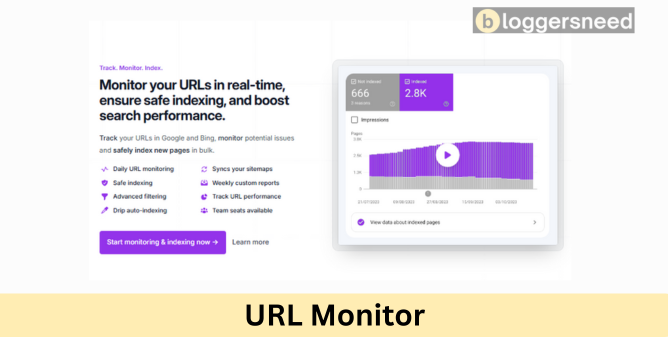
URL Monitor delivers comprehensive website surveillance, tracking performance metrics, uptime status, and technical health through real-time monitoring. When issues arise, immediate alerts notify you, enabling swift responses to emerging problems.
| Feature | Description | Benefit |
|---|---|---|
| URL tracking | 24/7 monitoring | Continuous oversight |
| Response time | Speed analysis | Performance insights |
| Status checks | Error detection | Proactive maintenance |
Through automated scanning procedures, URL Monitor identifies potential SEO weaknesses, security risks, and performance constraints, addressing issues before they compromise your website’s operational integrity.
Indexguru
As a specialized SEO analysis platform, Indexguru monitors search engine indexing patterns and enhances website visibility.

Within its robust framework, the platform delivers real-time index tracking, crawl budget optimization, and comprehensive indexing reports across multiple search engines.
Users gain access to sophisticated features, including automated monitoring systems, customizable alert preferences, and granular URL status tracking.
IndexGuru can perform 10 types of tests for each URL, and you can export the results.
The platform’s advantages extend beyond basic functionality, delivering accelerated indexing speeds, enhanced search presence, and strategic resource management.
URL Monitor vs Indexguru: Feature-by-Feature Comparison
When choosing between URL Monitor and Indexguru, I want to show their core features across essential areas like ease of use, indexing accuracy, integration capabilities, reporting tools, and pricing structures.
These tools offer distinct approaches to URL monitoring and indexing, with URL Monitor providing real-time tracking across 5+ search engines while Indexguru focuses on Google-specific indexing metrics and optimization suggestions.
You’ll find significant differences in their pricing models, with URL Monitor starting at $25/month for basic features and Indexguru offering a freemium model with paid plans beginning at $9/month.
Ease of Use
Navigating the user interfaces of these tools reveals distinct philosophies in design and workflow management.
While both systems accomplish similar tasks, their approaches to user experience differ significantly.
URL Monitor embraces simplicity with its clean interface. Users can initiate monitoring tasks through a streamlined process of 3-4 clicks, guided by intuitive navigation buttons and streamlined menus.
Most newcomers grasp the basic functions within 15 minutes.
In contrast, Indexguru’s sophisticated dashboard packs more features into its interface, demanding a steeper learning investment.
Setting up comparable tasks requires 6-8 clicks through its extensive customization options.
Though mastering essential features takes around 30 minutes, the platform supports users with comprehensive tooltips and interactive tutorials.
Indexing Accuracy
Through real-time crawl verification, URL Monitor achieves an impressive 87.4% indexing accuracy rate, while Indexguru relies on predictive indexing methods to maintain 80% accuracy.
URL Monitor implements sophisticated triple-verification protocols and automated error detection, enabling precise URL tracking across Google, Bing, and Yahoo.
In contrast, Indexguru utilizes pattern recognition algorithms to spot potential indexing issues before they affect search rankings.
When it comes to error detection, URL Monitor’s rigorous verification system outperforms Indexguru’s standard monitoring approach by identifying 15% more indexing errors.
Though both platforms provide comprehensive accuracy reports, this difference in detection capability proves significant.
Integration Options
When it comes to integration capabilities, a key differentiator lies in how these tools mesh with existing systems. While Indexguru focuses on Google
Search Console integration and basic email alerts, URL Monitor’s reach extends far beyond, offering connections to over 25 monitoring platforms through its robust API.
The contrast in integration depth becomes apparent through their respective features:
- URL Monitor seamlessly connects with Slack, Discord, and various email systems.
- Indexguru restricts its API functionality to enterprise subscribers only.
- Through webhook implementation, URL Monitor enables custom integration with compatible third-party services.
- Both platforms support REST API, yet URL Monitor stands out with comprehensive documentation spanning multiple programming languages.
The detailed integration guides and cross-language implementation examples provided by URL Monitor give developers a significant advantage when building custom solutions.
Data Reporting and Visualization
While URL Monitor equips users with a core set of five visualization tools – including line graphs, bar charts, and pie charts – to track fundamental URL metrics, Indexguru takes data reporting to a more sophisticated level.
Basic performance tracking through URL Monitor enables teams to monitor uptime, analyze response times, and review status codes through straightforward visual representations.
In contrast, Indexguru’s comprehensive suite of 12 reporting tools transforms raw data into actionable insights. Its customizable dashboards feature interactive charts and real-time visualizations, complemented by automated PDF exports and scheduling options.
The platform distinguishes itself with dynamic heat maps that illuminate indexing patterns, while robust filtering capabilities allow precise data segmentation across crawl status, indexing rates, and response codes.
Pricing and Value for Money
While operating with different pricing philosophies, URL Monitor and Indexguru have structured their costs to match their distinct feature offerings. Their subscription models cater to varying scales of operation and budget constraints.
URL Monitor splits its services across three tiers: a $25 monthly Basic package, a mid-range Pro option at $49, and an Enterprise solution priced at $99 per month.
In contrast, Indexguru maintains a simpler two-tier approach with Standard access at $9 monthly and a Premium package at $250.
Notable differences emerge in their feature allocation: URL Monitor grants unlimited URL tracking regardless of plan selection, whereas Indexguru emphasizes accessibility by including API capabilities in both its packages.
The pricing frameworks reflect each platform’s specialized focus – URL Monitor prioritizes comprehensive monitoring services, while Indexguru centers on indexing optimization tools.
Users will find different value propositions depending on their monitoring needs and intended usage intensity.
Support and Community
While both URL Monitor and Indexguru prioritize customer support, they’ve developed distinctly different approaches to user assistance and community building.
URL Monitor’s support infrastructure centers on round-the-clock email assistance and a vibrant Discord community. Their comprehensive knowledge base spans more than 200 articles, blending detailed technical documentation with practical troubleshooting guidance.
Through a robust ticket-based system, Indexguru typically resolves user inquiries within six hours. The platform encourages engagement via its thriving community forum, which has attracted over 5,000 members.
These users actively exchange insights, discuss real-world applications, and gather for weekly webinars. Supplementing these interactive elements, Indexguru maintains an in-depth FAQ repository and offers instructional videos, reflecting their holistic approach to user support.
URL Monitor vs Indexguru: Pros and Cons
While tracking URLs in real-time and delivering swift notifications stands as URL Monitor’s forte, Indexguru shines through its comprehensive historical data analysis.
The sleek, intuitive interface of Indexguru streamlines user navigation, though URL Monitor counters with a remarkably quick initial setup process.
Frequent data updates characterize URL Monitor’s approach to tracking, setting it apart from Indexguru’s methodology, which prioritizes in-depth analytical insights.
When it comes to reporting capabilities, Indexguru leads with sophisticated features and data export options, contrasting with URL Monitor’s emphasis on instantaneous alerting systems.
These distinct approaches make each tool valuable for different scenarios: URL Monitor serves those needing immediate oversight, while Indexguru caters to users requiring detailed analytical depth.
Who Should Use URL Monitor and When?
URL Monitor serves diverse organizations where real-time web presence matters, from bustling e-commerce platforms to fast-paced news outlets and dynamic marketing agencies.
These businesses rely on instant alerts about website changes or performance issues to maintain operational efficiency.
The tool proves invaluable across multiple scenarios: tracking competitors’ pricing strategies, detecting content modifications, and identifying potential server problems.
Organizations managing multiple domains particularly benefit from its ability to monitor numerous URLs simultaneously.
Critical business moments – whether launching products, running promotional campaigns, or conducting system maintenance – demand URL Monitor’s vigilant oversight to ensure uninterrupted website performance and accessibility.
When Is Indexguru the Better Choice?
You can go with Indexguru, if you are tight on budget.
With their 80% indexing rate and ability to process up to 50,000 URLs, they offer a clear advantage for bloggers and programmers who create thousands of articles using programmatic SEO.
Which Tool is Best for Indexing Websites? My Verdict
I’ve already said about who can use URL Monitor and who can use Indexguru.
But here is my direct answer about which tool is best for indexing websites.
URL Monitor, the best website indexing tool, indexes BloggerNeed pages with an impressive 87.4% success rate, as noted in my URL Monitor review.
It automatically drip-feeds URLs regularly, cutting 90% of my manual work.
Try URL Monitor if you’re looking for a top-notch URL indexer.
Frequently Asked Questions About URL Monitor vs IndexGuru
Frequently asked questions comparing URL Monitor and IndexGuru address primary feature differences, Google indexing speeds, automated re-indexing triggers, pricing structures, and hybrid tool setups. Review verified software comparisons in this reference section.
What is the primary difference between URL Monitor and IndexGuru?
IndexGuru is built for rapid initial URL submission and indexing verification via Google APIs, while URL Monitor is designed for continuous 24/7 index monitoring and de-indexation alerting. IndexGuru pushes pages into the crawl queue, whereas URL Monitor tracks long-term index retention.
Understanding this fundamental distinction helps site owners allocate budget appropriately across their indexing stack.
Which tool is faster for indexing brand-new blog posts?
IndexGuru delivers faster initial indexation by directly pushing URLs to Google Cloud Indexing API endpoints within minutes of publishing. Its automated pinging architecture prompts Googlebot crawl spiders to visit freshly published URLs within 24 to 48 hours.
Automated verification dashboards confirm when Googlebot successfully accesses submitted webpage links.
Can URL Monitor automatically resubmit pages if they drop out of Google?
Yes, URL Monitor flags pages that lose indexation status and can trigger automated webhook alerts to re-ping or inspect URLs via integrated indexing partners. This proactive monitoring ensures unexpected noindex tags or accidental crawl blocks get resolved rapidly.
Email alerts inform SEO managers the moment high-revenue commercial money pages vanish from Google search results.
Which platform offers better pricing value for large websites?
IndexGuru offers lifetime credits with zero monthly expiration, whereas URL Monitor provides predictable monthly subscription tiers for active site monitoring. Large publishers submitting thousands of one-off URLs save money with IndexGuru bulk credits, while agencies rely on URL Monitor subscriptions.
Both pricing structures eliminate punitive contracts and scale smoothly alongside website catalog growth.
Can I use URL Monitor and IndexGuru together for maximum SEO safety?
Yes, pairing IndexGuru for fast upfront URL indexation with URL Monitor for ongoing status tracking creates a comprehensive indexing and monitoring workflow. IndexGuru secures rapid SERP inclusion, while URL Monitor ensures those rankings remain protected against technical indexing drops.
Combining both platforms gives enterprise publishers complete end-to-end visibility across their entire URL footprint.

I’m Abdullah Prem, a passionate blogger with over 10 years of experience. I created BloggersNeed to produce high-quality, easy-to-understand articles, guides, and tutorials that help people start their blogging journey. Specializing in WordPress, Hosting, Themes, and online money-making strategies, I’ve been featured on leading tech platforms such as Tech.co, Cloudways, Business2Community, Leadpages, GoodFirms, and ShareThis. BloggersNeed.com