
Off-page SEO techniques are strategic actions executed outside your website boundaries to increase domain authority, search engine trust, and organic keyword rankings across Google SERPs.
Search engines treat high-quality external backlinks as algorithmic votes of confidence. While on-page SEO strategies optimize your internal content structure, off-site link acquisition directly determines whether your web pages outrank high-authority competitors for competitive commercial search queries. Combining white-hat outreach, authority PR, contextual curation, and community distribution generates sustainable organic referral traffic.
Analyzing link profiles requires professional audit software. Digital marketers use SEO tips and enterprise competitive intelligence platforms to discover backlink gaps, evaluate PageRank distribution, and eliminate toxic link footprints across global campaigns.
Top 11 Off-Page SEO Techniques Comparison Matrix
The comparative performance matrix below evaluates all 11 off-page link building strategies across execution difficulty, primary link attribute, algorithmic risk level, and long-term ranking impact.
| Off-Page Technique | Link Attribute | Execution Difficulty | Algorithmic Risk | Ranking Impact |
|---|---|---|---|---|
| 1. Guest Posting | Dofollow / Editorial | Moderate to High | Very Low | Highest |
| 2. Q&A Link Building (Quora) | Nofollow / UGC | Low | Zero | Moderate (Referral Traffic) |
| 3. Social Bookmarking | Nofollow / Curation | Low | Low | Fast Indexation |
| 4. Blog Commenting | Nofollow / UGC | Low | Low to Moderate | Foundation Relevance |
| 5. Press Releases | Nofollow / Sponsored | Moderate | Low | Brand Authority |
| 6. Forum Marketing | Nofollow / Dofollow | Moderate | Low | High CTR & Leads |
| 7. Web 2.0 Subnetworks | Dofollow | Moderate | Moderate | Tiered Entity Stacking |
| 8. Profile Links | Nofollow / Dofollow | Low | Low | Brand Entity Identity |
| 9. Directory Submissions | Dofollow / Nofollow | Low | Low to Moderate | Local Geo Relevance |
| 10. Resource Page Outreach | Dofollow / Editorial | Moderate | Zero | High Evergreen Value |
| 11. Private Blog Networks (PBN) | Dofollow / Contextual | High | High | High Velocity (Controlled) |
11 Best Off-Page SEO Techniques for Top SERP Rankings
Each off-page optimization technique provides distinct structural advantages for search engine crawlers and human audiences. Executing these 11 methods builds comprehensive algorithmic trust and referral traffic.
1. Guest Posting (Editorial In-Content Link Building)
Guest posting is the process of pitching, authoring, and publishing comprehensive educational articles on authoritative third-party websites within your specific commercial niche to secure high-tier contextual dofollow backlinks.
The screenshot below demonstrates how search engines index authoritative guest contributions across relevant publishing portals.
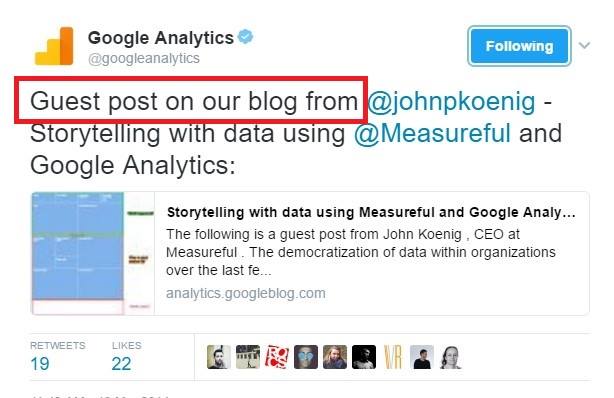
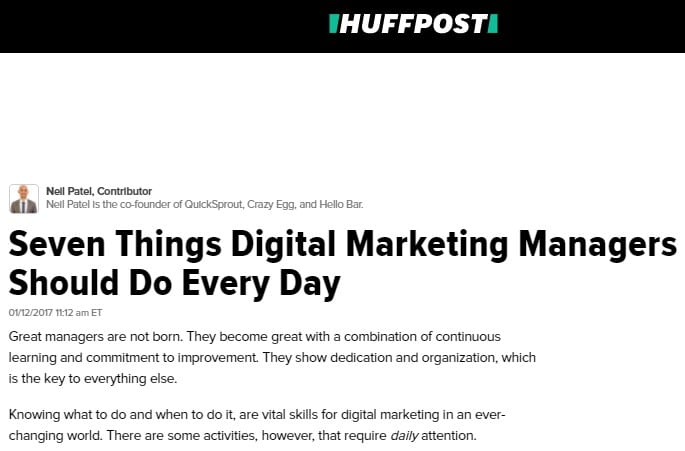
Editorial guest blogging remains the most durable white-hat off-page strategy because links are surrounded by topical semantic co-occurrences. Pitching websites with DA 50+ and real organic traffic transfers legitimate PageRank to your target URLs. Prominent digital marketers use guest posts on mainstream news sites and industry portals to establish thought leadership.
The image below shows Neil Patel publishing guest content on major editorial platforms like The Huffington Post to drive authority and brand signals.
The primary steps for successful guest blogging outreach are outlined below.
- Niche Discovery: Search Google using operators such as
"niche" + "write for us"or"niche" + "guest post guidelines"to identify active publications. - Metric Validation: Verify that target sites receive a minimum of 5,000 monthly organic visitors and maintain a low spam score below 5%.
- Data-Driven Pitching: Propose 3 unique headline topics that solve direct informational gaps for the host publication audience.
- Contextual Anchor Placement: Integrate natural, non-commercial anchor text inside the body paragraphs pointing to deep internal resource pages.
2. Q&A Platform Link Building (Quora & Answer Engines)
Q&A link building is the practice of publishing expert answers on high-traffic question-and-answer portals like Quora, Reddit, and Stack Exchange to capture targeted referral audiences and contextual brand citations.
The screenshot below illustrates how structured answers on Quora attract thousands of organic impressions and direct referral clicks.
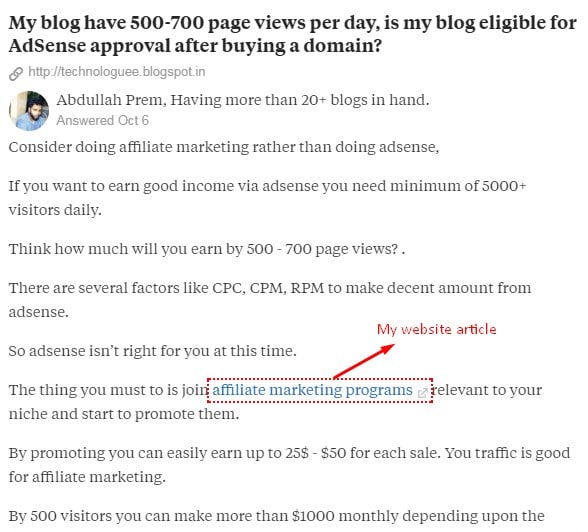
Search engines reward active entity mentions on community discussion engines. Publishing in-depth responses to popular questions establishes topical subject authority. You can read our detailed guide on how to make money on Quora for answering questions to monetize targeted community engagement.
The best practices for extracting value from Q&A platforms are listed below.
- High-Intent Question Selection: Target questions ranking on Google page 1 for informational keywords with over 1,000 weekly views.
- Comprehensive Problem Solving: Write 300 to 500 word breakdown answers that solve the user question directly before citing reference materials.
- Natural Resource Linking: Add a contextual link to your relevant tutorial as supplementary reading rather than pure self-promotion.
- Profile Entity Branding: Complete your author bio with verifiable credentials and website links to pass topical trust.
3. Social Bookmarking & Content Curation
Social bookmarking is the submission of web page URLs, metadata, and summaries to social curation networks to accelerate Google crawler discovery and generate initial engagement signals.
The image below shows how social bookmarking platforms index curated blog content for rapid distribution.
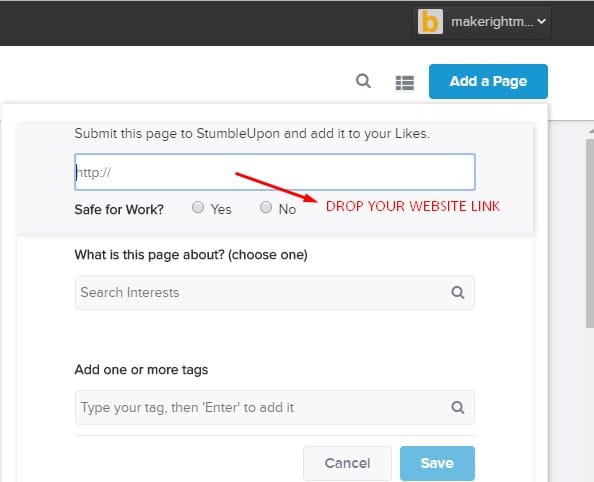
Web platforms like Mix, Pocket, Digg, Scoop.it, and Pinterest index submissions quickly. Submitting new articles to top bookmarking repositories creates diverse referral paths, expedites indexing for fresh URLs within 24 to 48 hours, and supplies supplementary social signals that support organic visibility.
The essential rules for social bookmarking submissions are summarized below.
- Unique Tagging Architecture: Select 3 to 5 hyper-relevant categorical tags for every submitted URL to align topical clustering.
- Compelling Headline Copy: Craft click-worthy, descriptive titles that accurately reflect the primary value proposition of the content.
- Community Interaction: Bookmark high-quality content from other publishers across the platform to maintain natural profile activity.
- Platform Diversification: Spread submissions across at least 8 to 10 verified bookmarking portals rather than spamming a single repository.
4. Niche Blog Commenting
Niche blog commenting is the strategic addition of insightful, value-packed feedback on active industry blogs that include a natural link to relevant research within the author website field or comment body.
The screenshot below demonstrates an example of engaging in constructive blog discussions to build networking relationships with webmasters.
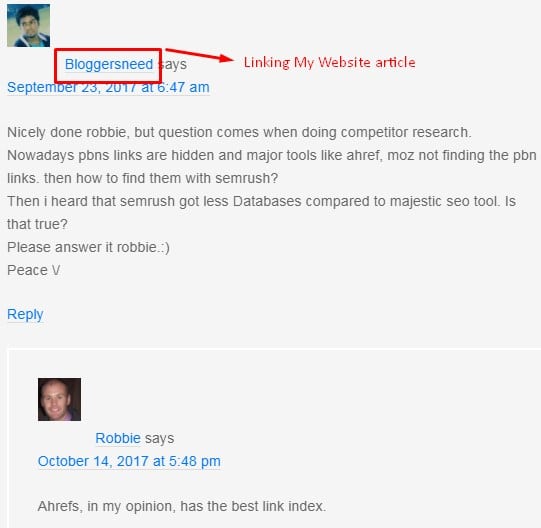
While most blog comment links utilize rel="nofollow" or rel="ugc" attributes, they play a vital role in building a natural anchor text profile and establishing niche relevance. Search engines examine the surrounding co-occurring terms in comments to assess topic affinity. Finding active blogs accepting comments is straightforward with advanced search operators.
The image below displays targeted Google search dorks used to locate high-traffic niche blogs with open comment sections.
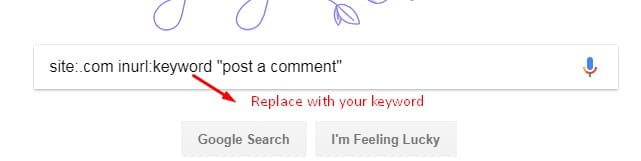
The core guidelines for high-impact blog commenting are detailed below.
- Google Search Dorks: Use queries like
"keyword" + "leave a comment","keyword" + "post a comment", or"keyword" + "add comment". - Value-Add Feedback: Expand on points made in the article by offering original perspectives, data points, or practical field observations.
- Real Persona Branding: Use your actual personal name rather than commercial anchor keywords in the name field to avoid immediate moderation rejection.
- DoFollow Comment Hunting: Identify platforms running CommentLuv or specialized comment systems that reward active participants with contextual links.
5. Press Release Distribution
Press release distribution is the broadcast of newsworthy corporate announcements, product launches, or proprietary research studies across syndicated media networks to secure brand mentions and news media citations.
Distributing news releases via platforms such as PR Newswire, Business Wire, and EIN Presswire syndicates your company profile across hundreds of regional news affiliates. Although syndicated links generally carry rel="sponsored" or rel="nofollow" tags, they establish institutional trust signals, build unlinked brand mentions, and generate editorial coverage from journalists seeking reference data.
The fundamental practices for effective press release campaigns are listed below.
- Genuine Newsworthiness: Base releases on proprietary industry survey findings, major software milestones, or original data studies.
- Direct Quote Inclusion: Provide quotable commentary from company executives to encourage journalists to reference your brand.
- Boilerplate Precision: Maintain a consistent corporate address, website link, and media contact information across all distribution wires.
- Follow-Up Media Outreach: Contact journalists covering your specific beat directly with personalized pitches following the wire distribution.
6. Forum Marketing & Community Discussions
Forum marketing is the active participation in specialized online message boards and niche communities to address technical challenges, answer queries, and share relevant resources with highly targeted audiences.
The screenshot below illustrates how active participation on established niche forums creates steady referral traffic and authoritative backlinks.
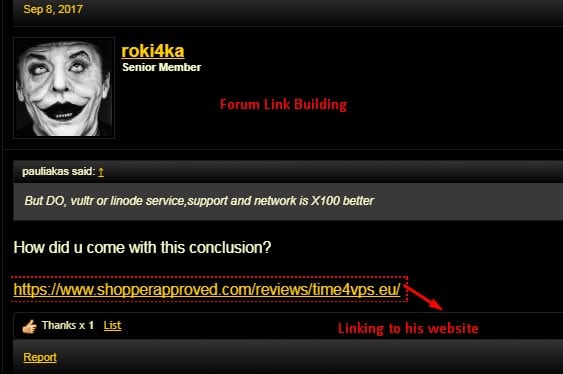
Communities like Warrior Forum, BlackHatWorld, DigitalPoint, Reddit subreddits, and platform-specific message boards attract engaged practitioners. Consistently providing constructive advice builds profile trust, allowing you to add signature links and contextual citations that direct warm leads to your digital assets.
The recommended execution steps for forum marketing are presented below.
- Thread Activity Filtering: Identify discussion threads with more than 500 total views and active conversations within the last 30 days.
- Profile Warming: Publish at least 15 to 20 helpful replies before attempting to share external web links or portfolio assets.
- Signature Link Integration: Utilize forum signature spaces for brand links to establish continuous baseline entity exposure across every post.
- Relevance Matching: Only link to external articles when they directly solve a complex question raised in the ongoing discussion thread.
7. Web 2.0 Subnetwork Link Building
Web 2.0 link building is the creation and maintenance of standalone branded blogs on high-authority hosted platforms like WordPress.com, Blogger, Medium, and Wix to publish supporting contextual articles that pass tiered equity to primary target pages.
The visual mind map below details how to structure tiered Web 2.0 subnetwork properties around your primary money site.
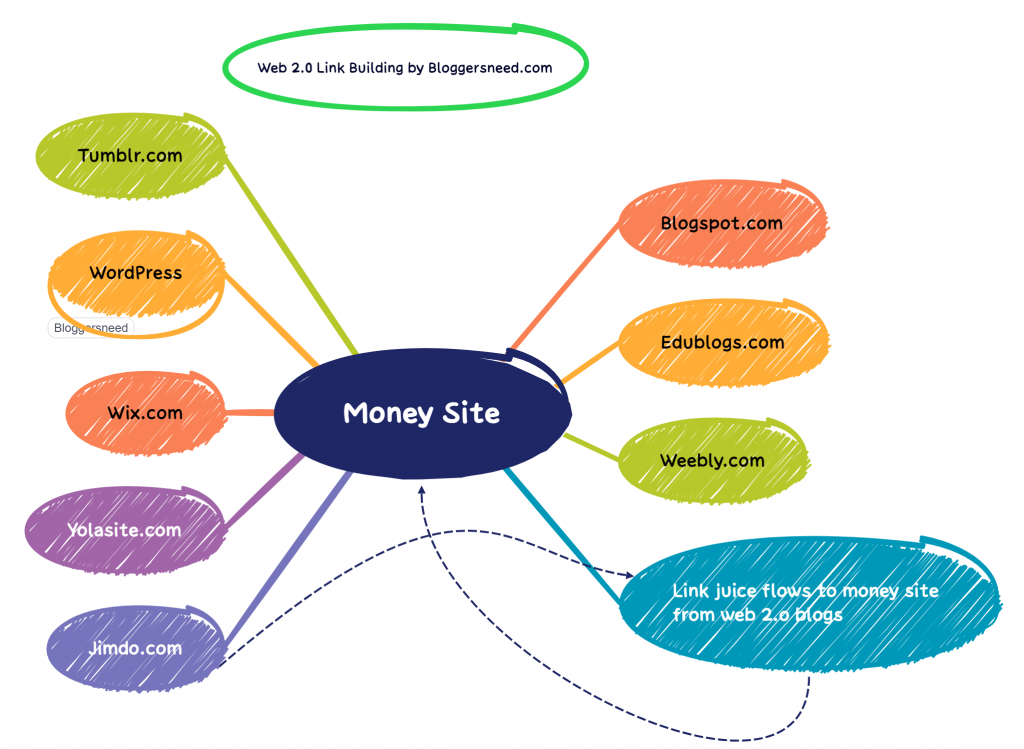
Tiered link building leverages the built-in domain authority of third-party platforms. When creating secondary properties, treating each subdomain as an authentic publication with dedicated media, unique editorial copy, and social profiles produces safe contextual backlinks. Check our curated directory of top web 2.0 websites to source high-trust hosting platforms.
The essential tactics for building high-quality Web 2.0 properties are outlined below.
- Unique Content Publishing: Post 800+ word original articles on each subdomain to prevent automated platform deletion and spam flags.
- Theme Customization: Configure custom banners, navigation menus, and about pages to establish individual site authenticity.
- Natural Co-Citations: Include links to trusted external resources like Wikipedia and industry associations alongside your money site link.
- Tier-Two Backlinking: Build foundation links to your Web 2.0 properties to amplify the PageRank equity transferred to your main domain.
8. High Authority Profile Link Creation
Profile link creation is the systematic registration of your brand across high domain authority platforms, software registries, portfolio hubs, and community forums to establish consistent entity data and reserve corporate naming rights.
The screenshot below demonstrates how optimizing user profiles on authoritative portals creates clean, brand-validated backlinks.
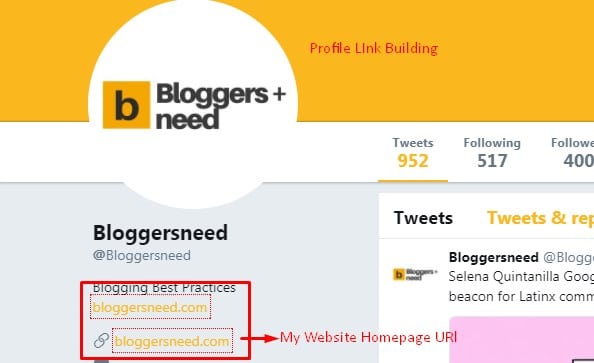
Creating verified profiles on portals like GitHub, TED, Behance, Crunchbase, Gravatar, and Vimeo solidifies your Knowledge Graph footprint. These foundational links reinforce your site’s domain authority and protect brand identity across the global search index.
The key execution standards for profile link building are summarized below.
- NAP Consistency: Ensure Name, Address, and Phone details match corporate directory listings across every single registration.
- Complete Profile Optimization: Upload high-resolution logo avatars, social links, and detailed 100+ word company mission statements.
- Dofollow Profile Prioritization: Target developer platforms and design portfolios that render live crawlable dofollow links to homepages.
- Indexation Acceleration: Share newly created profile URLs on social channels to ensure search crawlers discover and index them promptly.
9. Directory & Citation Submissions
Directory submission is the listing of your business website details under specific categorical taxonomies within curated online web directories and local citation repositories.
The image below shows the submission workflow for submitting your web portal to verified industry web directories.
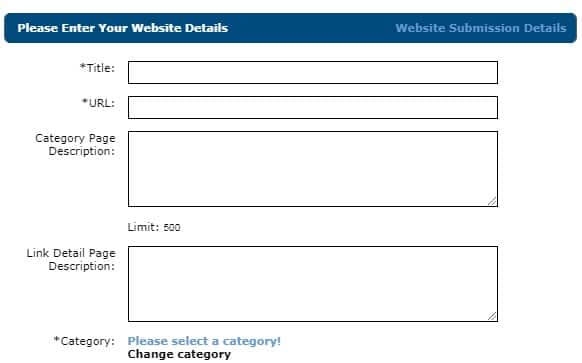
While low-quality automated web directories are obsolete, submission to human-edited niche directories and established regional platforms (such as YellowPages, Yelp, Hotfrog, and industry trade associations) remains critical for local SEO and geo-targeted ranking relevance. Review our updated database of directory submission websites to identify verified directories.
The best practices for submitting to online web directories are detailed below.
- Human-Edited Directory Selection: Choose directories that employ manual editorial reviews rather than instant unmoderated approvals.
- Precise Subcategory Placement: Select the exact subcategory that mirrors your primary service offering to maximize semantic relevance.
- Unique Descriptive Snippets: Write tailored 50 to 100 word descriptions for each submission to avoid duplicate content penalties.
- Local Citation Verification: Maintain identical NAP consistency to improve rankings inside Google Local 3-Pack listings.
10. Resource Page Link Building & Outreach
Resource page link building is the outreach method of finding web pages that curate lists of valuable tools, guides, and articles within your industry and pitching your high-quality content as an essential addition.
The screenshot below displays how resource page links appear on educational and industry reference directories.
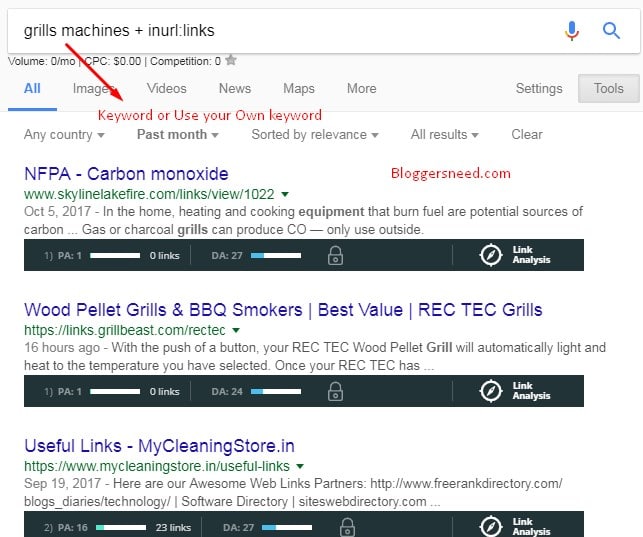
Resource pages exist explicitly to link out to helpful external content, making webmasters receptive to outreach when presented with comprehensive, updated guides. Because resource pages are curated by hand, links obtained from these pages deliver strong editorial authority, high referral clicks, and lasting organic rankings.
The step-by-step process to secure resource page backlinks is listed below.
- Search Operator Discovery: Run queries such as
"topic" + inurl:resources,"topic" + "useful links", or"topic" + "helpful resources". - Broken Link Identification: Use link checking tools to locate broken links on target resource pages and offer your live guide as a replacement.
- High-Value Asset Creation: Ensure your proposed resource offers calculators, original data, or comprehensive walkthroughs superior to existing links.
- Personalized Outreach: Contact the page curator directly, pointing out why your guide enhances the educational value for their readers.
11. Private Blog Networks (PBN) & Controlled Authority Networks
Private Blog Networks (PBNs) are networks of authoritative websites built on expired or auctioned domains used to pass concentrated link equity and exact-match anchor text to target commercial assets.
Deploying PBNs provides full control over anchor text placement and content relevance. However, search engines penalize networks with shared hosting footprints, duplicate WHOIS data, or low-quality spun articles. Practitioners who choose to buy PBN backlinks or build private networks must prioritize strict hosting isolation, unique DNS configurations, and varied IP classes to avoid detection.
The technical requirements for running safe authority networks are summarized below.
- Domain Due Diligence: Audit archive history to ensure the domain never hosted spam, adult content, or foreign language redirects.
- Hosting Footprint Elimination: Distribute sites across separate hosting providers, CDN services, and unique A/B/C class IP blocks.
- Content Depth: Publish 1,000+ word original articles with custom media and diverse outgoing citations to authoritative sources.
- Anchor Text Diversification: Restrict exact match commercial anchors to under 15% to maintain a natural algorithmic link profile.
Frequently Asked Questions About Off-Page SEO Techniques
The most common questions regarding off-page search engine optimization and link building strategies are answered below.
What is the most effective off-page SEO strategy for fast rankings?
Editorial guest posting and resource page outreach are the most effective off-page SEO strategies for sustainable ranking improvements. Securing contextual dofollow backlinks on active websites with DA 50+ passes authentic PageRank and semantic topical signals that push commercial pages to Google page 1.
Do nofollow backlinks help with search engine rankings?
Nofollow backlinks assist search engine rankings by diversifying your backlink profile and driving qualified referral traffic. Google treats rel="nofollow", rel="ugc", and rel="sponsored" links as algorithmic hints that provide contextual relevance and natural link distribution.
How many backlinks are needed to rank on Google page 1?
The number of backlinks required to rank on Google page 1 depends on target keyword difficulty and competitor link velocity. Low-competition queries require 5 to 10 high-quality contextual links, whereas competitive commercial keywords often require 50 to 100+ authoritative referring domains.
What is the difference between on-page and off-page SEO?
On-page SEO involves optimizing internal factors directly on your website including content quality, heading tags, internal links, and page speed. Off-page SEO focuses on external authority signals including backlinks, digital PR mentions, social signals, and brand citations across external web properties.
Affiliate Disclosure: Some of the links in this post are affiliate links, which means I may earn a small commission if you make a purchase through those links. This comes at no extra cost to you. Thank you for your support!

I’m Abdullah Prem, a passionate blogger with over 10 years of experience. I created BloggersNeed to produce high-quality, easy-to-understand articles, guides, and tutorials that help people start their blogging journey. Specializing in WordPress, Hosting, Themes, and online money-making strategies, I’ve been featured on leading tech platforms such as Tech.co, Cloudways, Business2Community, Leadpages, GoodFirms, and ShareThis. BloggersNeed.com
Thanks for this informative blog as its going to help me a lot in On page SEO for my next blog
Great Article!
Thanks For Sharing such an informative article with perfect example pictures.
Very Nice Information!!!
Very New Information
Thank you so much for sharing this.
It’s very helpful for newbies bloggers.
Thanks for sharing interesting article on off page seo, its really helpful
I hope these all strategy helps.
The information is very clear Off-Page SEO method with the help of relevant snapshots. Thanks for sharing it.
I must say you have explained well these off-page SEO techniques to increase any website traffic and build backlinks to a website. In this fast growing world, SEO techniques always keep changes time to time and the worst part is that you might not even know it. That’s why you always need to stay updated with the latest trends and techniques in SEO. Search Engine algorithm being updated every minute, it is hard to know for an SEO company or individual which techniques still working.
The blog was absolutely fantastic! Lot of great information which can be helpful in some or the other way. Keep updating the blog, looking forward for more content.
Thanks for sharing.
The best webpage for tips on off page SEO. Thank you so much for sharing this article. I’ve bookmarked this page also.
Nice information
Thanks for writing such a good article on backlinks. It is not bendy in backlinks. People always try direct method but most of time these trick don’t works. Your tips are helpful for the person to make good backlinks for their websites or blog. This content is so valuable and surely unique that people are happy and really helpful for them. any pressure from your side, neither in the form of request nor hint or reminder in any ways.
Thanks
Thank you so much for sharing this great information with us.But I would like to ask you one thing can I use spin content for the article submission & Web 2.0?