


The interface visual above illustrates the core workflow to locate specific numerical identifiers assigned across WordPress posts and pages.
Every WordPress installation organizes content items by assigning an integer identifier during initial database insertion. Locating these numerical values allows administrators to execute advanced configuration tasks without writing complicated search scripts.
Whether configuring template hierarchy rules, applying targeted style sheets, or executing API endpoints, knowing how to locate individual identifiers proves essential. Developers frequently inspect these records to troubleshoot rendering errors and manage dynamic page logic.
In this updated 2026 guide, we explain five reliable methods to locate any post or page ID quickly across modern WordPress environments.
What is Post ID in WordPress?
A WordPress post ID is a unique numerical integer automatically generated within the wp_posts database table to identify specific content entries. This static key distinguishes individual articles, custom post types, revisions, and media attachments across complex database queries and dynamic templates.
WordPress relies on relational database architecture where each entry receives an auto-incrementing primary key. This numerical index remains unchanged even when updating permalinks, post titles, or publishing statuses across multiple administrative revisions.
Administrators use these identifiers to configure custom sidebars, query specific categories, and selectively enable or disable plugin features. For instance, you can showcase individual articles or configure dynamic widget features using post ID references inside custom loop filters.
Beyond manual customizations, third-party extensions and translation suites rely on numerical IDs to map multilingual relations. Understanding this database foundation simplifies advanced site maintenance across production environments.
Why You Need to Locate WordPress Post and Page IDs
Locating WordPress post and page IDs is necessary for applying custom CSS selectors, configuring shortcode parameters, setting exclusion rules in navigation menus, and executing REST API queries. These unique numerical identifiers ensure precise programmatic targeting without relying on mutable URL slugs.
Modern block builders and shortcode engines frequently require post IDs to display dynamic content carousels, custom author boxes, or related reading blocks. Inputting exact ID numbers prevents display errors caused by slug alterations.
Advanced stylesheet customization also relies heavily on these identifiers. The WordPress template engine automatically injects unique ID classes into the document body, allowing designers to style isolated landing pages without affecting overall site design.
Security configurations and optimization suites often request exclusion IDs to bypass caching rules or deactivate scripts on transactional checkouts. If a conflicting script causes administrative lockouts, learning how to disable plugin files from cPanel provides a reliable recovery route.
How to Find Post ID in WordPress
To find a WordPress post ID, navigate to Posts or Pages in your dashboard, hover over any title, and inspect the preview link in your browser footer. Alternatively, edit the article to read the post parameter directly inside the browser address bar.
WordPress provides multiple integrated pathways to locate identifiers without requiring direct database access. Administrators can extract these keys through administrative URL inspection, dedicated column plugins, page source inspection, or browser developer tools.
The following sections detail each method systematically, helping you select the ideal technique for single post checks or bulk catalog audits.
Method 1: Using the URL
The administrative URL method reveals a post ID by hovering over an edit link or opening the post editor directly. The browser address bar displays the query string post equals followed by the numeric ID assigned to that specific WordPress publication.
When site administrators need to find post id wordpress records, inspecting the administrative URL provides the fastest direct route. You do not need to install additional plugins or run database queries.
First, log into your WordPress administrative panel and click on Posts or Pages in the left sidebar menu. Hover your cursor over the title of the article you wish to examine.
Look at the bottom left corner of your browser window. You will see a destination link containing post.php followed by an integer query string.
Alternatively, click the post title to enter the block editor screen. Observe the URL in your browser address bar to read the assigned number.
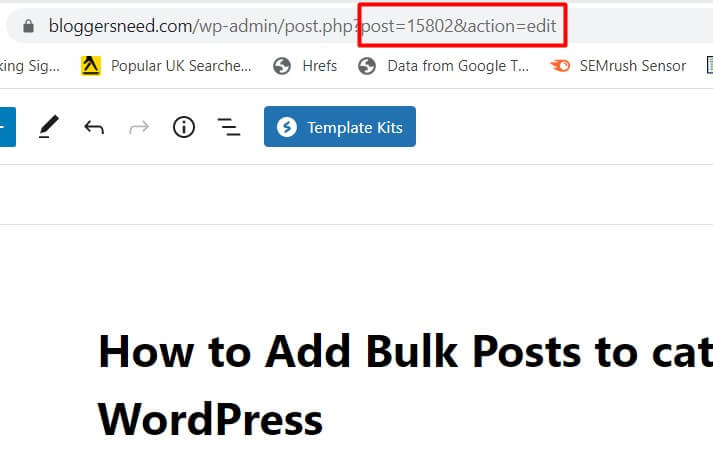
The screenshot above captures the administrative URL structure where the post parameter displays the unique integer assigned to the edited content.
In the demonstrated example, the URL contains post equals 15802. That specific five-digit integer represents the unique post ID required for shortcodes or template hooks.
This administrative approach also explains how to find page id in wordpress without installing external utilities. The exact same query parameter appears when editing standard pages.
Method 2: Catch IDs Plugin
The Catch IDs plugin displays numerical identifiers in dedicated dashboard columns across posts, pages, categories, tags, and media. Installing this lightweight administrative utility allows site owners to review bulk post IDs instantly without opening individual edit screens or inspecting browser source code.
Inspecting individual URLs works well for occasional checks, but auditing multiple posts requires a faster workflow. Installing a dedicated Catch ID’s plugin adds persistent ID columns across your WordPress management screens.
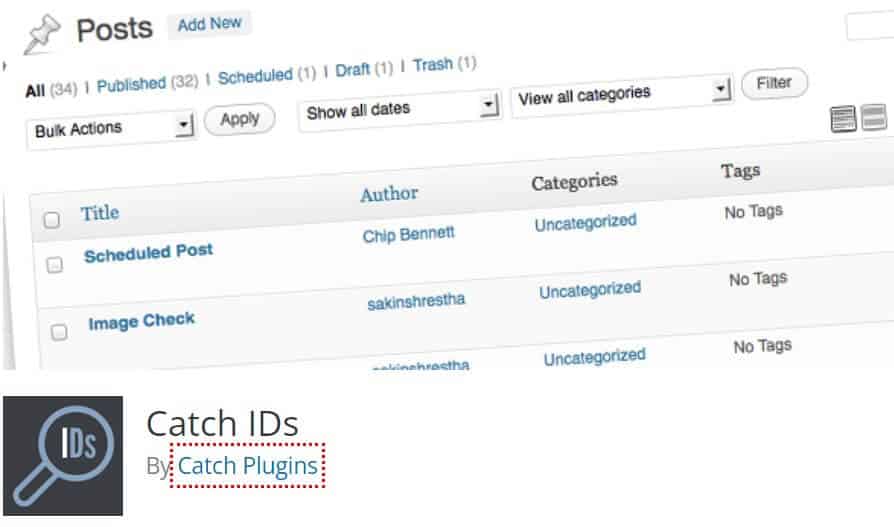
The visual above shows the Catch IDs repository listing within the WordPress plugin directory interface.
To activate this wordpress page id finder, navigate to Plugins and select Add New. Search for Catch IDs, click Install Now, and activate the extension.
Once activated, navigate to Posts and select All Posts. The management table instantly displays an ID column next to each post title.
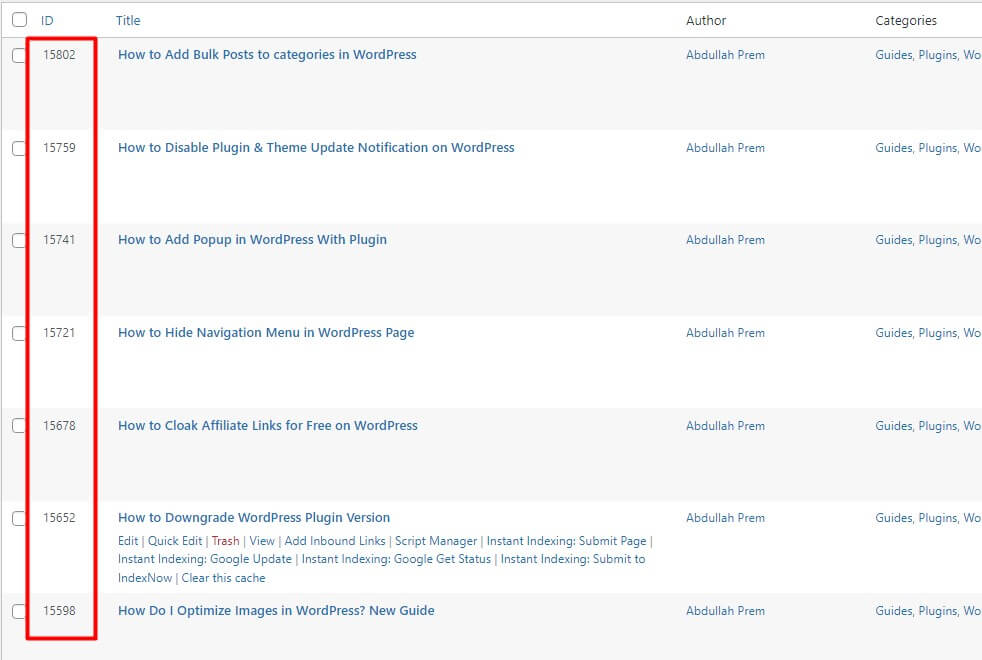
The table display shown above demonstrates how Catch IDs presents bulk identification numbers across all published articles simultaneously.
Site administrators can customize which content types display ID columns. Navigate to Settings and choose Catch IDs to toggle columns for categories, tags, custom post types, and user profiles.
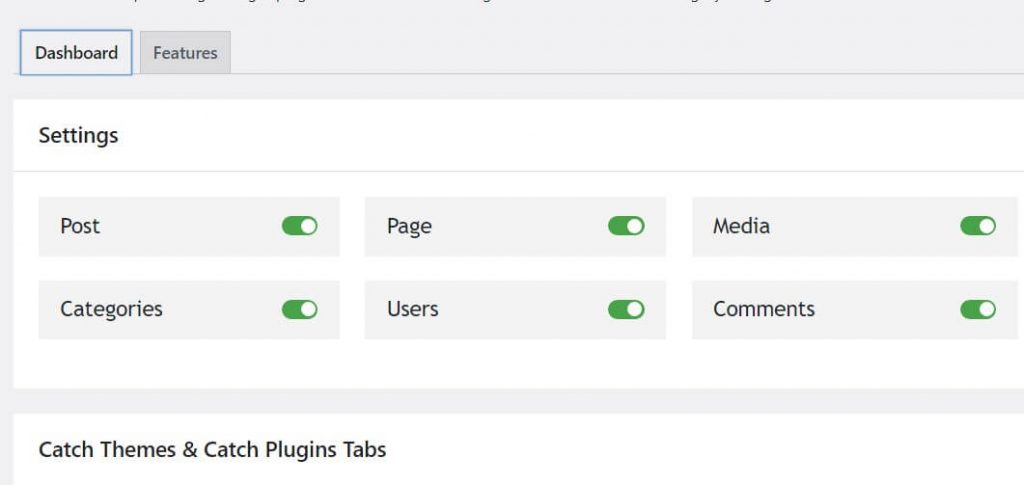
The configuration screen above depicts the Catch IDs settings panel where administrators select specific post types and taxonomies for ID column display.
This extension operates with minimal database queries, ensuring administrative page loading speeds remain uncompromised during daily editorial workflows.
Method 3: Using View Page Source
Viewing the HTML page source reveals post IDs directly from the rendered frontend markup. By searching for postid inside the body class attribute using browser search tools, you can extract the exact numerical identifier without logging into the administrative dashboard.
If you need to find wordpress post id values on a published website where you lack administrative login credentials, inspecting the frontend source code provides an immediate answer.
Open any published article in Google Chrome, Firefox, or Safari. Right click on any neutral section of the page and select View Page Source from the context menu.
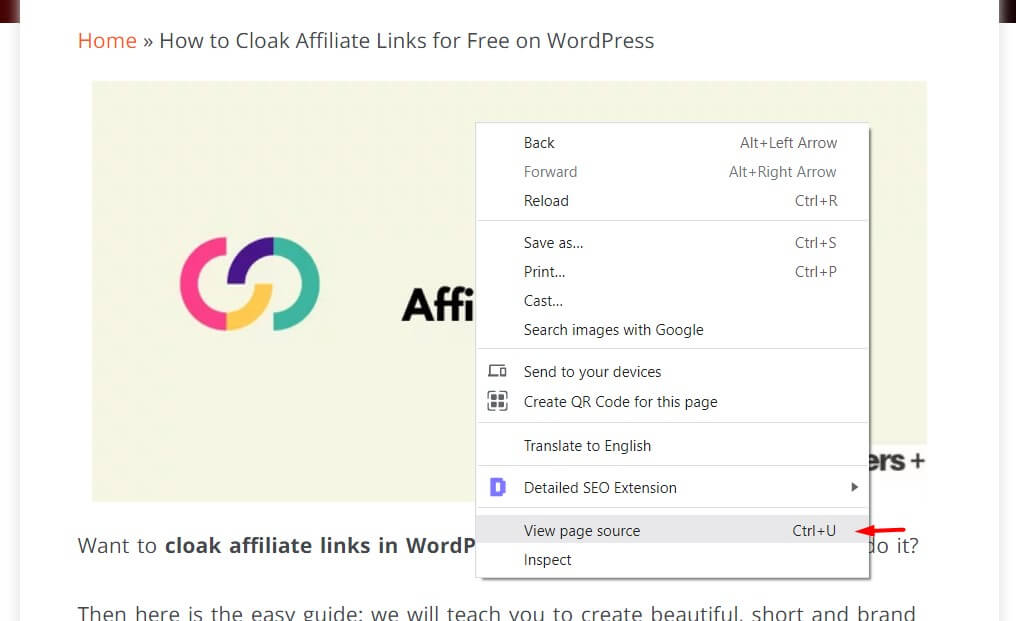
The context menu image above shows the browser option to open and inspect rendered HTML markup on any live website.
A new browser tab will open containing the complete rendered HTML markup. While raw code can look overwhelming, your browser search shortcut simplifies the discovery process.
Press Ctrl plus F on Windows or Command plus F on macOS to launch the in-page search bar. Type postid into the query box.
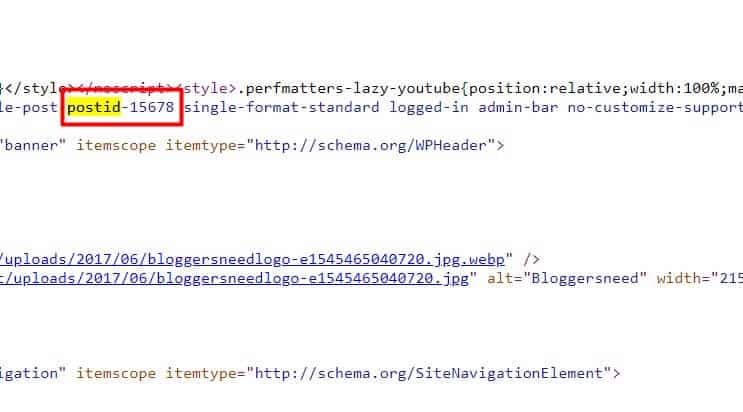
The highlighted search capture above identifies the postid class attribute embedded directly within the primary HTML body element.
The search highlights the body tag class list containing postid-15678. The digits immediately following the hyphen represent the unique post ID of that live article.
For standard static pages, WordPress instead inserts page-id- followed by the corresponding number. Both patterns allow rapid identification without administrative privileges.
Method 4: Using Browser Developer Tools and DOM Inspection
Browser developer tools allow developers to locate WordPress post IDs by inspecting the document body or article wrapper in the DOM tree. Opening the Elements panel instantly reveals body classes like postid-1234 without opening full source tabs or scrolling through markup.
Developers who write custom CSS rules often prefer using browser developer tools over opening the complete source tab. This workflow enables immediate inspection while testing responsive layout properties.
Right click anywhere on the webpage and select Inspect. The developer tools panel will open, displaying the active Document Object Model structure.
Locate the opening body element near the top of the Elements tab. WordPress automatically includes classes such as single-post and postid- followed by the post integer.
You can also inspect individual article containers. Themes commonly output an id attribute formatted as post- followed by the ID number on the main wrapper.
Method 5: Finding Post IDs via WordPress REST API
The WordPress REST API allows developers to retrieve post and page IDs programmatically by querying official wp-json endpoints. Appending wp-json wp v2 posts directly to your domain returns structured JSON data containing the exact numerical ID assigned to every published entry.
For headless WordPress setups or programmatic migration scripts, querying the REST API provides the cleanest automated pathway. You can fetch ID records using any HTTP client or browser window.
Enter your domain followed by /wp-json/wp/v2/posts?slug=your-post-slug in your browser address bar. The browser displays a JSON array containing the record metadata.
The first attribute in the returned JSON object is id, accompanied by its unique numerical integer. This technique proves indispensable when automating content synchronization across external services.
How to Find Category and Tag IDs in WordPress
To find category or tag IDs in WordPress, navigate to Posts and select Categories or Tags, then hover your cursor over the term name. The browser preview link displays tag_ID equals followed by the unique numerical integer assigned to that taxonomy term.
In addition to posts and pages, taxonomy terms such as categories and tags possess unique database identifiers. Developers frequently need taxonomy IDs to configure widget filters or custom navigation queries.
Navigate to Posts and click Categories. Hover your mouse cursor over any category title to inspect the preview link in your browser status bar.
The URL displays edit-tags.php?taxonomy=category and includes the parameter tag_ID= followed by the number. That numerical value represents the category ID for your theme functions.
How to Find Media Attachment IDs in WordPress
To find media attachment IDs in WordPress, navigate to Media and select Library, switch to the list layout view, and hover over the file title. The browser status bar URL reveals item equals followed by the unique attachment identifier number.
Images, audio files, and downloadable documents receive standard post IDs because WordPress stores attachments inside the primary wp_posts database table. Themes and plugins frequently request attachment IDs to generate responsive image sets.
Open your Media Library and click the list icon in the top left corner. Hovering over any media item title reveals the URL containing upload.php?item= followed by the ID integer.
Alternatively, clicking the file opens the edit media screen, where the browser address bar displays post equals followed by the exact media ID.
Comparison of WordPress ID Discovery Methods
Comparing WordPress ID discovery methods helps webmasters choose between administrative URL inspection for quick checks, column plugins for bulk inventory reviews, and source inspection for frontend audits. Each technique provides distinct operational advantages based on individual user permissions and site technical requirements.
The following comparison matrix summarizes the key characteristics, access requirements, and ideal use cases for each ID discovery method.
| Discovery Method | Access Required | Best Use Case | Execution Speed | Plugin Needed |
|---|---|---|---|---|
| Administrative URL | Editor or Admin | Single post or page checks | Instantaneous | No |
| Catch IDs Plugin | Administrator | Bulk catalog auditing | Rapid overview | Yes (Free) |
| View Page Source | Public Frontend | Live site inspection | Moderate | No |
| Browser DevTools | Public Frontend | CSS targeting & theme debugging | Instantaneous | No |
| REST API Endpoint | Public or Editor | Programmatic data scripts | Automated | No |
Common Troubleshooting Issues When Locating WordPress IDs
Troubleshooting WordPress post ID issues involves identifying aggressive caching conflicts, custom permalink rewrites, missing administrative columns, or theme overrides that alter standard body classes. Understanding these operational factors ensures dependable ID retrieval across diverse hosting environments and heavily customized WordPress installations.
Occasionally, administrators encounter situations where standard ID discovery methods behave unexpectedly. Caching plugins may serve stale frontend markup, hiding recent ID class assignments.
Clearing server cache and local browser cache resolves frontend source discrepancies. If custom body classes are missing, verify that your active theme includes the body_class template tag inside header.php.
When using column plugins, screen options settings occasionally hide newly added fields. Click Screen Options in the top right dashboard corner to confirm the ID checkbox remains active.
Frequently Asked Questions About WordPress Post and Page IDs
WordPress post and page IDs generate automated primary keys that remain stable across routine database updates and permalink revisions. Addressing common practitioner questions regarding ID modifications, media identification, and database structure clarifies how WordPress manages internal content indexing and retrieval efficiently.
Can a WordPress Post ID Ever Change Automatically?
A WordPress post ID never changes automatically because it serves as an immutable auto-incrementing primary key inside the MySQL database. Modifying post titles, permalinks, publish dates, or author assignments preserves the original numerical ID throughout the lifecycle of the content.
The only scenario where an ID changes is if you permanently delete the post and recreate it manually. In that case, WordPress allocates the next sequential database integer.
How Do I Find the ID of a WordPress Media File?
To find a WordPress media file ID, navigate to Media and click Library, then switch to the list view layout and click your desired file. The browser address bar displays item equals followed by the exact numeric attachment ID for that asset.
Alternatively, hover over the edit link in media list view to inspect the destination URL. Media attachments exist inside the wp_posts database table, receiving standard post IDs upon upload.
Is There Any Difference Between a Post ID and a Page ID?
There is no structural difference between a post ID and a page ID because WordPress stores both core content types inside the exact same wp_posts database table. Both receive unique sequential integers differentiated solely by the post_type database column value upon initial creation.
Because posts and pages share this table, a post and a page can never possess identical numerical IDs within the same WordPress installation.
How Can I Find a Post ID by Its Title or Slug in Code?
To find a post ID programmatically in PHP code, utilize the native get_page_by_path function or execute a custom WP_Query filtering by post_name. Passing the clean URL slug into the function returns the complete post object containing the unique ID property.
Developers can also use url_to_postid passing the full permalink to retrieve the corresponding numerical identifier dynamically within custom plugins and template files.
Conclusion
Finding post and page IDs in WordPress is a straightforward task achievable through URL inspection, free plugins like Catch IDs, page source search, or developer tools. Selecting the appropriate discovery technique streamlines template customization, widget configuration, and plugin management across your website.
Whether applying custom styling, configuring shortcodes, or troubleshooting script conflicts, knowing how to quickly identify content IDs saves valuable administrative time.
For single posts, inspecting the administrative address bar remains the quickest zero-setup solution. For regular bulk audits, activating Catch IDs adds effortless visibility across your entire content catalog.
More WordPress Guides
Explore our comprehensive collection of WordPress tutorials and technical configuration guides to enhance your website functionality. These hands-on practitioner walkthroughs cover custom widget setup, navigation menu layout styling, image optimization, and essential administrative maintenance workflows for modern WordPress site administrators.







I’m Abdullah Prem, a passionate blogger with over 10 years of experience. I created BloggersNeed to produce high-quality, easy-to-understand articles, guides, and tutorials that help people start their blogging journey. Specializing in WordPress, Hosting, Themes, and online money-making strategies, I’ve been featured on leading tech platforms such as Tech.co, Cloudways, Business2Community, Leadpages, GoodFirms, and ShareThis. BloggersNeed.com
Thank you for providing good content it’s really helpful.